Probate & Trust Guidance · Real Estate · Compassionate Advocacy

No One Prepared Me for This How to Walk Through Trusts, Probate, and Grief with Grace

If you're holding this book, whether you're in grief, in conflict, or in freefall, know this: you've found someone who won't let you drown. This is not just a guide. It's a lifeline for anyone carrying responsibilities they never asked for, navigating emotions they weren't prepared for, and somehow finding strength they never knew they possessed.

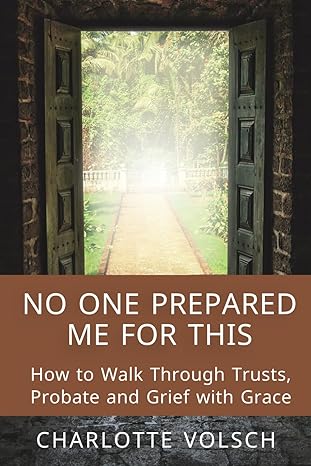
No One Prepared Me for This by Charlotte Volsch — Book Cover
Explore
"She didn't just show up with forms and timelines. She stepped into the chaos and offered calm. They kept the roof over my head while I figured out how to stand again."
Bryant Matthews — Foreword

The Premise

Probate Is Rarely Just Paperwork

It's the weight that lands in the silence. It's continuing to function when everything around you has stopped. It's navigating responsibilities and decisions while wrapped in grief's heavy blanket. When someone you love passes away, there's that moment when grief collides with responsibility — and suddenly, you're facing decisions you never prepared for.

This book was written for the person standing at that intersection of practical action and emotional preparation. Through real stories of real people, Charlotte Volsch walks beside you through every phase: from the first overwhelming hours after loss, through the complexities of sorting belongings and settling estates, to the quiet moment when the paperwork is done but the heart is still processing.

Whether you're reading this in anticipation of responsibilities to come or finding yourself already immersed in them, know that there is wisdom to guide you and compassion to hold you. You're not alone in feeling unprepared. And you don't have to walk this path alone.

The Promise

What You'll Find in These Pages

🤲
Compassionate Guidance

Not just instructions and checklists, but someone who understands that every document you organize and every decision you make is an act of love.

🪨
Firm Footing

Clear, structured approaches for navigating trust administration, probate filings, property decisions, and family dynamics — turning the overwhelming into the manageable.

🕊️
Grace for the Journey

Permission to be human through it all. Some days you'll accomplish everything on your list. Other days you'll barely get out of bed. Both are valid. Both are necessary.

The Journey

Ten Chapters. One Path Forward.

Chapter One

When It All Lands at Once

The Tender Weight of First Steps

When grief collides with responsibility — navigating the critical first days, building your support system, and finding the balance between duty and devotion.

I stared at my phone as Audra's message illuminated the screen, softly worded, yet heavy with an unspoken ache. For two years, these messages had arrived like gentle waves, each one carrying the weight of her mother's declining health. Each text shared a doctor's visit, a scan result, or a question she couldn't bear to ask anyone else. And each time, after responding with all the strength and clarity I could offer, I would set down my phone and cry. Not just because Audra is like a daughter to me, but because watching someone you love navigate the slow, painful loss of their rock, their person, teaches your heart a new kind of stretching.

You've probably felt this too — that helpless ache when someone you care about is suffering, and all you can do is bear witness. That struggle between offering practical guidance and simply being present in their pain.

The Journey Before Goodbye

Her mother's battle had been relentless. Hospital stays blurred into chemotherapy sessions, which melted into long nights where prayers seemed the only force stronger than the pain. Through it all, Audra wasn't merely a daughter — she became her mother's steady presence, her tireless advocate, her at-home nurse, her prayer partner, and her unwavering strength.

As Thanksgiving approached that year, I could sense the shift in her messages. The words grew gentler, the tone more surrendered. We moved between discussing practical matters — home ownership documents, account access, service arrangements — and the profound spiritual terrain of preparing to say goodbye. I reminded her often that faith doesn't erase grief; it simply holds your hand through it.

Think about the thresholds you've stood at in your own life. Those moments when you balanced mundane logistics with soul-deep emotion. When you wondered if you were doing enough, being enough, or preparing enough for what was coming. That intersection of practical action and emotional preparation is perhaps one of life's most sacred and difficult spaces to navigate.

When her mother passed the day after Thanksgiving, everything landed at once — the silence after the storm, the hollow after the final exhale, and the inevitable question we all face when the unthinkable becomes reality: "What now?"

Preparation Meets Presence

What saved Audra from drowning in that moment wasn't just her faith — it was her foresight. Months earlier, we had worked through the practical matters together. The home was properly titled, bank accounts were accessible, and everything possible had been done to avoid probate. I had guided her through each piece with gentle confidence, assuring her: "You've already handled what needed handling. Now, your only job is to be present."

And she was, magnificently so.

I watched the Florida memorial service through streaming video, tears falling and smiles forming simultaneously as Audra spoke with remarkable clarity and light. Her voice never wavered as she honored her mother's story with reverence and grace. That's the extraordinary thing about Audra — her joy and sorrow have always held hands, and her voice, even in grief, echoes her mother's enduring faith.

Navigating the Fog

Even with meticulous preparation, Audra described those first days after her mother's passing as moving through dense fog. The phone calls, coordination of services, the memorial in Florida — everything blurred into a swirl of logistics wrapped in raw emotion.

Her clarity didn't emerge from certainty; it came from trust. She trusted the choices made before the end. She trusted the love poured into every detail. She trusted the prayers covering it all.

When you're in this position, decisions that once seemed simple may now require triple the mental energy. Tasks that normally take minutes might stretch into hours. This isn't failure — it's the reality of processing loss while handling practical matters. Be gentle with yourself. Trust that the fog gradually lifts.

Moving Forward with Grace

If I could offer just one piece of advice for those first 24 hours, it would be this: "You don't have to do it all today."

You need to understand this truth: probate is rarely just paperwork. It's the weight that lands in the silence. It's continuing to function when everything around you has stopped. It's navigating responsibilities and decisions while wrapped in grief's heavy blanket.

There is a path forward. And you don't have to walk it alone.

Chapter Two

After the Goodbye

The Next Right Step

When the sympathy cards taper off but the mountain of decisions remains. Organizing those first weeks, the documents that matter, and building your circle of support.

The call came at 8:47 on a Tuesday morning. Jeannie's voice cracked as she spoke, the kind of fracture that only appears when someone is trying desperately to hold themselves together. "Charlotte, I don't know what to do next," she whispered. Her husband's funeral had been three days ago, and now reality was setting in — the reality that comes after the casseroles stop arriving and the sympathy cards taper off. The reality that you're suddenly expected to understand legal terms, financial procedures, and property transfers while your heart is still learning how to beat differently.

I could picture her sitting at her kitchen table, probably still in her robe, staring at a pile of papers that suddenly held the power to determine her future peace of mind. But what Jeannie couldn't see was that she was already taking the most crucial step: reaching out.

When the Details Feel Like a Tidal Wave

When I arrived at Jeannie's home that afternoon, her son Michael was already there. He stood by the living room window, hands in pockets, shoulders hunched forward like he was bracing for impact. The death certificate lay on the coffee table beside a thick binder labeled "Family Trust" in her husband's precise handwriting. Neither of them had touched it.

"He named me successor trustee," Michael said, the words hanging awkwardly in the air. "I don't even know what that means, not really." The hesitation in his voice reminded me of so many others I've guided through this process — brilliant, capable people suddenly questioning their ability to handle the simplest tasks because grief has temporarily rewired their brains.

I sat between them on the sofa and placed my hand over Jeannie's. "Let's start with what you know, not what you don't," I said. "Tell me about Robert."

Her eyes softened then, and for the next twenty minutes, she told me about her husband — his meticulous nature, how he'd organized their financial life, how he'd insisted on creating the trust five years ago "just in case." As she spoke, I noticed Michael's posture gradually relaxing. Sometimes, before diving into documents, we need to remember the person behind them.

Finding Your Footing in Unfamiliar Territory

"I don't even know where to begin," Jeannie admitted. The anxiety in her eyes was familiar — it's that moment when the to-do list feels endless, and every task seems equally urgent. That's when overwhelm takes root.

"We begin with security, then work outward," I explained, taking a notebook from my bag. "Let's create three categories: what needs immediate attention, what can wait until next week, and what can be addressed next month."

I watched the relief wash over both their faces as we began sorting tasks into manageable chunks. There's something profoundly calming about having someone say, "This first, then that, then the other thing." The path forward may still be steep, but at least now, there are steps carved into the mountainside.

The Documents That Open Doors

"We'll need multiple death certificates," I explained to Jeannie and Michael, watching as they made notes. "More than you think you'll need. Financial institutions, insurance companies, government agencies — many require originals, not copies."

Michael looked surprised. "I only ordered five," he admitted.

"Let's order ten more," I suggested. "You can always keep extras, but running out creates unnecessary delays."

We moved methodically through the document checklist — the trust and its amendments, Robert's will, property deeds, insurance policies, bank statements, tax returns. Each one we located and organized in a dedicated folder. Each folder represented one less roadblock in the journey ahead.

When Your Heart and Legal Obligations Collide

The hardest moment that afternoon came when we discussed notifying financial institutions of Robert's passing. Jeannie's hand trembled as she looked at the list of accounts.

"Every time I make one of these calls, I have to say it out loud," she whispered, tears welling. "That he's gone. It makes it real all over again."

Michael moved to sit beside his mother, arm around her shoulders. The legal necessities of death often force us to confront our loss repeatedly in sterile, procedural ways that feel at odds with the sacredness of grief.

"Would it help if I made some of these calls with you?" I offered. "Or if Michael handled a few?"

She nodded gratefully. This is something many forget — you don't have to shoulder every notification, every form, every phone call yourself. Delegation isn't just practical; it's an act of self-compassion.

Moving Forward Without Moving On

Before I left that evening, we had assembled clear folders, created a priority list, identified immediate next steps, and scheduled a follow-up meeting. However, the most important outcome wasn't captured in any document or checklist.

It was the subtle shift in Jeannie's posture — slightly more upright, slightly more present. It was Michael's more confident tone when he spoke about his role as successor trustee. It was the sense that while nothing would ever be the same, they could navigate this new terrain together.

"We're not trying to 'get over' anything," I reminded them as I packed my bag. "We're simply finding a way to carry your love for Robert alongside these new responsibilities."

Jeannie smiled for the first time that day. "He would have appreciated your organization," she said. "And he would have been proud of us for figuring this out."

That's what this journey is ultimately about — honoring the person you've lost by caring well for what they've left behind. Not just assets or accounts, but the life they built, the values they cherished, and the people they loved. There is a path forward. And as Jeannie and Michael discovered that afternoon, you don't have to find it alone.
Chapter Three

Letting Go with Love

Honoring the Life, the People, and the Things Left Behind

Navigating rooms full of memories — sorting through belongings with both efficiency and reverence, when timelines meet heartlines.

I remember the first time I saw the garage. Tools hung on pegboards with careful precision — wrenches arranged by size, screwdrivers sorted by type, and specialized automotive tools that I couldn't even name. The concrete floor was swept so clean you could have eaten off it. And in the center stood a partially restored Mustang, its glossy red paint gleaming under the fluorescent lights, a silent testament to hours of patient craftsmanship.

Matthew stood in the doorway behind me, arms crossed tight against his chest. His eyes scanned the space like he was memorizing it, afraid it might disappear if he looked away. "Dad was halfway through replacing the transmission," he said quietly. "We were supposed to finish it this summer."

The unfinished project hung in the air between us — a promise interrupted, a conversation cut short. I felt Joseph shift uncomfortably beside me. As the legally appointed personal representative for his father's estate, he had responsibilities, timelines, and court requirements to meet. But at that moment, standing in the sanctum of his estranged father's passion, he wasn't thinking about probate. He was watching his younger half-brother grieve.

When Timelines Meet Heartlines

Joseph had called me the week before, his voice carrying the distinct tension of someone trying to do the right thing while having no emotional roadmap to follow. "The attorney said you could help," he explained. "I haven't seen my father since I was two. Now I'm responsible for his entire estate, and I have no idea where to begin."

His story unfolded slowly over coffee at a local diner — how his father had left him and his twin brother John when they were toddlers, how he'd gone on to start another family, how Matthew had been born twenty years later into a completely different relationship with the same man. Now, with their father gone, Joseph found himself legally responsible for an estate that felt like a stranger's, while Matthew was drowning in grief over the loss of his mentor, his father, and his friend.

"I need to move this process forward," Joseph sighed, turning his coffee mug slowly between his palms. "But Matthew acts like I'm erasing Dad every time I mention sorting through things or preparing the house for sale." He looked up, his eyes revealing more compassion than resentment. "I don't want to be the bad guy here. I just don't know how to balance the legal obligations with his need to... hold onto everything."

Finding the Bridge Between Brothers

"What if we approach this differently?" I suggested. "Instead of focusing first on what needs to go, let's start with what Matthew might want to keep."

That conversation led us to the garage that day, where Matthew now stood protectively among his father's projects and paraphernalia. I noticed Joseph taking it all in — not just the things, but his brother's attachment to them. Something shifted in his expression.

"Tell me about the car," Joseph said softly, stepping toward the Mustang. "What were you working on with him?"

The question opened a door. Matthew's posture relaxed slightly as he moved to the driver's side, pointing out the custom details, explaining the modifications, sharing stories about late nights with their father cursing over stripped bolts and celebrating small victories. Joseph listened, asking questions and creating space for his brother's memories, and something shifted between them.

The Story Behind the Things

The kitchen drawers revealed the first moment of unexpected emotion. Matthew pulled open what appeared to be a junk drawer, filled with rubber bands, expired coupons, takeout menus, and a jumble of other random items. He stared at it for a long moment, then began to laugh — a sound that quickly transformed into something closer to a sob.

"This was the first tool he ever gave me," he said so quietly I almost missed it. "I was twelve. He said every man should know how to fix what's broken." The memory hung in the air between them. "But some things you can't fix."

Joseph moved closer, his own hands in his pockets. "No," he agreed. "Some things you can't."

In that shared truth, something settled between them — an acknowledgment that loss is real, that some absences can't be filled, and that moving forward doesn't mean pretending otherwise.

Carrying Forward What Matters Most

The day they handed the keys to the new owner, Joseph and Matthew stood together in the empty garage. The Mustang was gone, sold to an enthusiast who had promised to complete the restoration with respect for its history.

"It feels strange," Matthew admitted, his voice echoing slightly in the empty space. "Like we're leaving him behind."

Joseph considered this, then shook his head. "I think it's the opposite," he said quietly. "For the first time, I feel like I'm taking him with me."

In that simple exchange lies the profound truth at the heart of letting go: We do not honor the dead by freezing their spaces in time. We honor them by carrying forward what truly matters — the love, the lessons, the connections that transcend physical things.

Chapter Four

Decisions, Disagreements, and Doing What's Right

When Not Everyone Sees the Same Path Forward

When doing the right thing puts a target on your back. Family dynamics, false accusations, and finding the courage to choose integrity over ease.

The first time Shawn broke down in my office, she wasn't crying about her mother's death. She was crying about her brother's email — the one where he accused her of "manipulating Mom's finances" and "controlling access" during their mother's final years. The one that ended with a thinly veiled threat about "legal consequences" if she didn't step down as personal representative.

My desk tissues were no match for this kind of pain. This wasn't just grief — it was betrayal, layered on exhaustion, wrapped in disbelief.

"I bathed her," Shawn whispered, her hands trembling around the mug of tea I'd placed between us. "I measured her medications at 4 a.m. I held her hand through chemo. Where was Steven then? Five years, Charlotte. Five years I put my life on hold, and now he wants to swoop in and tell me I did it wrong."

When Service Becomes a Battle

Shawn's story began years before her mother's passing. At 68, her mother had been diagnosed with a rare form of cancer that gradually diminished her cognitive abilities. Shawn, the middle child of three siblings, lived closest and had the most flexible work situation. What started as weekly check-ins evolved into daily care, and eventually, Shawn moved into her mother's home to provide round-the-clock support.

"My brother visited twice that first year," she told me. "Called maybe once a month. My sister lived out of state but sent care packages and called weekly. I didn't resent it then. We all have different lives and different capacities. I was just focused on Mom."

When her mother's condition necessitated legal intervention, Shawn petitioned for conservatorship, a decision her siblings acknowledged with distant approval. She meticulously documented expenses, kept detailed care notes, and regularly updated her family on their mother's condition. Every major decision was communicated, even if responses were sparse.

The Storm After the Calm

After her mother's peaceful passing, Shawn continued in the role she had held for years. The court formally appointed her as personal representative, a natural extension of her conservatorship. She began the process of inventorying assets, notifying creditors, and preparing her mother's modest home for eventual sale.

Then came Steven's first email. Then his calls. Then his sudden appearances at the house, demanding to "supervise" as she sorted through belongings.

"He wanted to see bank statements from three years ago," Shawn explained, frustration edging her voice. "He implied I had been taking Mom's money. He questioned every decision — from the hospice service I'd selected to the funeral home costs. It was like he was building a case against me rather than helping settle her estate."

Finding Solid Ground in Shifting Terrain

When Shawn first called me, she wasn't looking for property guidance — she was drowning in family dysfunction and looking for a lifeline. Together, we developed a strategy that became her anchor through the storm — a dual focus on what she could control and what she needed to protect.

First, we created clear boundaries and communication protocols. Shawn would only discuss estate matters through proper channels, either in writing or with the probate estate attorney present. Second, we shifted her focus from defending past actions to documenting current ones. Third, we began preparing the property for sale despite the ongoing legal challenges.

When the Court Confirms What You Already Knew

The final hearing arrived nine months after her mother passed. When the judge finally spoke, the ruling was unambiguous. Not only was Shawn confirmed as personal representative, but Steven's objections were characterized as "without merit" and "causing undue delay to the settlement of the estate."

In the hallway afterward, Shawn didn't celebrate. She simply exhaled a long, slow release of tension she had been carrying for months.

"It's over," she whispered.

The Dignity of Doing What's Right

The day after the final court hearing, Shawn called with news that surprised me. "Steven left a voicemail," she said. "He wants to help with the final clearing of Mom's workshop. He said he's sorry things got out of hand."

"I'm thinking that I can be right without needing him to admit I'm right," Shawn said. "I'm thinking Mom would want us to find some way forward, even if it's awkward and imperfect."

"I did the right thing," she said finally. "Not the easy thing. The right thing." Righteousness doesn't always require vindication. Sometimes, it simply means continuing to act with dignity, even when others have not extended the same courtesy to you.

Chapter Five

The Weight of What's Left Behind

Cleaning, Clearing, and What to Do with Everything

The special silence in a home that still holds someone's presence. Practical and emotional approaches to preparing property while preserving meaning.

The silence hit me first when I stepped across the threshold — not an empty silence, but one that felt dense with memories, as if the air itself had been undisturbed for weeks. Jason's mother's home stood suspended in time, her glasses still on the side table, her slippers still by her favorite chair, her calendar still marking appointments she would never keep.

I watched Jason move ahead of me down the hallway, his shoulders slightly hunched as if carrying an invisible weight. His wife Debbie followed closely behind, her eyes moving between her husband and the rooms surrounding them, her hands clasped tightly together as if anchoring herself.

I could feel the weight of what they were carrying — not just the loss of Jason's mother but the recent passing of Debbie's parents, too. Layer upon layer of grief, complicated by an estranged relationship with Jason's younger brother.

When Stillness Speaks Volumes

"I don't know where to start," Jason said finally, his voice barely above a whisper. He gestured toward the hallway that led to more rooms, more belongings, more memories. "Mom saved everything. Every card we ever gave her. Every school project. Thirty years of photos in boxes."

"We're still finishing up with Debbie's parents' estate," he continued. "And now this. It feels... overwhelming."

Debbie nodded, her eyes suddenly bright with unshed tears. "And Jason's brother won't help, but he'll certainly have opinions about what we decide."

I let the silence settle between us for a moment, honoring the magnitude of what they were facing. Sometimes, the most compassionate response isn't immediate action or even words of comfort — it's simply bearing witness to the reality of someone's struggle without rushing to "fix" it.

Finding Firm Ground in the Overwhelm

After listening to their concerns — both spoken and unspoken — I gently reflected back what I was hearing: the exhaustion in their voices, the uncertainty about where to begin, the complicated family dynamics that added another layer of pressure.

"What if we approach this in steps?" I suggested, my voice soft but clear in the stillness of the living room. "Not everything needs to be decided today."

I outlined a simple but structured approach: I would connect them with a reputable estate sales professional. They would take their time identifying specific items they wanted to keep. I would secure the property and begin assessing what needed to be done to prepare it for potential new owners. We would create a timeline that respected both their emotional needs and the practical requirements of the estate.

As I spoke, I could see Debbie's shoulders gradually relaxing. When I finished, she let out an audible sigh — the kind that comes when someone finally puts down a burden they've been carrying too long.

"I'm so glad you were recommended to help us," she said, her voice steady despite the tears still shining in her eyes. "You've lifted such a weight and given us firm footing where I felt lost and floating."

When Firm Footing Replaces Floating

At the end of our first visit, Debbie had looked at me with such profound relief and said those words I've carried with me into countless similar moments with other families: "You've lifted such a weight and given us firm footing where I felt lost and floating."

Those words capture the essence of this chapter — not the logistics of sorting belongings or preparing property, but the profound human need for grounding in the midst of transition. For someone to walk beside you through the rooms still filled with absence. For gentle guidance when every decision feels weighted with meaning.

If you're in the middle of clearing a loved one's home right now, may you know this truth: it's okay to feel overwhelmed. It's okay to need help. It's okay to move slowly through certain rooms and quickly through others. What matters isn't that you handle everything perfectly but that you move through this experience with intention and care — both for the legacy you're tending and for your own heart doing the tending.

Chapter Six

Clarity, Choices, and the Crossroads

Sell, Rent, or Hold

When a property becomes more than a house — it becomes the focal point for grief, family dynamics, and decisions that impact relationships for years to come.

The tiny two-bedroom house looked almost exactly as it had for the past forty years — modest and unassuming from the curb, yet somehow, it had managed to hold a family of seven with more love than square footage. But now, instead of warmth, the air inside crackled with tension as Victor stood silent in the doorway of his childhood bedroom, listening to the raised voices of his siblings in the kitchen.

"She lived here rent-free for almost two years!" his older brother's voice carried down the hallway. "With her whole family. While we all paid our own mortgages."

"She was taking care of Mom," Victor heard himself say as he joined them. "Veronica gave up everything to be here."

The look his oldest brother gave him could have frozen water. On the other side of the kitchen, Veronica's eyes were rimmed red, her husband's hand resting protectively on her shoulder. The division wasn't just emotional — it was physical, with clear battle lines drawn across their mother's worn linoleum floor.

When Legacy Meets Reality

Veronica and her husband had been named co-administrators of the estate. They had moved from Arizona with their two children twenty months earlier when her mother's cancer diagnosis had turned serious. They had left their own home, their jobs, and their community — all to provide the round-the-clock care her mother needed in her final chapter.

Now, with her mother gone, Veronica was being accused of taking advantage of the situation. Her oldest brother wanted immediate sale of the property and equal distribution of proceeds. He argued that she owed the estate back-rent for the time she and her family had lived in the home.

"We need to sell it and move on," he insisted. "That's what's fair. You got to live here for free. We should at least get our share of what the house is worth."

Building Bridges, Not Reinforcing Walls

My first meeting with Veronica and her husband revealed the depth of their pain. It wasn't just the accusations that hurt — it was the dismissal of their sacrifice over the previous two years.

"I just can't believe they see it that way," Veronica said, her voice breaking. "We gave up everything to be here for Mom. And now they want to erase all that and just talk about money."

Rather than immediately diving into property options, we spent time acknowledging the multiple losses at play. Then we began building a bridge — not between the divided siblings directly, but between what seemed like opposing goals.

"What if there was a way to keep the home in the family AND ensure everyone receives their fair financial share?" I suggested. "Let's explore all the options before assuming we're at an impasse."

This reframing shifted the conversation from a zero-sum game to a search for mutual benefit. Victor emerged as a potential solution — what if he purchased the house at fair market value? The property would stay in the family, fulfilling their parents' wish, while the proceeds would still be distributed equally among all siblings.

Finding the Path That Brings Peace

After weeks of exploration, negotiation, and careful planning, a path forward emerged. Victor would purchase the home at fair market value. Veronica and her husband would help with payments for the first year and would complete the necessary repairs. The proceeds would be distributed equally among all siblings. The house would remain in the family, honoring their parents' wishes.

The closing day arrived with mixed emotions. Victor later told me that as they signed the final papers, his older brother had briefly placed a hand on his shoulder and said, "Dad would be proud you're keeping the place." It wasn't a full reconciliation, but it was an acknowledgment of shared history.

When Property Becomes a Bridge, Not a Barrier

Months after the sale was completed, I received a call from Victor. He was hosting a small gathering at the house — the first family dinner since their mother's passing where all the siblings would be present.

"Mom always said this place was built for family," he told me. "I guess I'm trying to rebuild that too."

The property that had initially divided them was now becoming a tentative bridge back to connection — because the solution had honored something larger than individual preferences. It had honored the legacy of the family itself.

Chapter Seven

Preparing for the Market While Protecting Your Heart

Listing, Showing, and Letting Go

When a space filled with memories must be prepared for strangers to evaluate. The tender crossroads between heart's valuation and market realities.

I'll never forget the moment Casandra handed me her father's house key. Her hand trembled, creating a soft chime in the silence between us. She'd called me three days earlier, her voice barely above a whisper, explaining that she needed help with her father's home after his unexpected passing. What had begun as a hopeful recovery from cancer surgery had ended abruptly when a blood clot took him without warning.

"I'm the administrator," she said, the legal term sounding foreign on her tongue. "But I can barely walk through the front door without breaking down. And my brother keeps calling from Oregon asking when he'll get his money."

Have you felt that weight? That impossible tension between your heart, which wants to preserve everything exactly as it was, and your responsibilities, which demand movement forward?

The Paralysis of "Not Yet"

For three months after our initial meeting, Casandra existed in what I call the limbo of "not yet." One week, she would call, voice firm with resolve: "I think I'm ready to start preparing the house." But when the day arrived, another call would come: "I'm sorry, I just can't do it today. It doesn't feel right yet."

"I feel like I'm betraying him," she admitted one afternoon as we sat at her father's kitchen table. "Like I'm erasing him by getting the house ready to sell."

I reached across and covered her hand with mine. "There's a difference between the legal timeline of probate and your personal timeline of grief," I told her. "One has court dates and deadlines. The other has no schedule at all. Both are valid, and both need to be honored."

Finding Movement Through Support

"I can't sort through his clothes," Casandra told me one day. "But maybe I could let you help with the garage. He wasn't out there much after he got sick."

That became our starting point. As Casandra watched us work with care and respect, something shifted in her. Not dramatically, but perceptibly, like ice beginning to thaw at its edges. She started making small decisions: this tool set would go to her husband, that workbench could be sold, those fishing rods would return to her brother in Oregon.

"It helps to not do this alone," she admitted. "I've been trying to carry everything by myself."

The Moment the Sign Goes Up

After weeks of gradual progress, we reached the day when the "For Sale" sign would go in the front yard. Casandra was sitting on the front porch, hands wrapped around a mug of tea, watching the morning light play across her father's garden.

"Do you think he would be upset about the house being sold?" she asked.

"What do you know about what mattered most to your dad?" I asked her.

Casandra's expression softened. "Family. Us being okay. He hated waste and always said things were just things, it was people that mattered."

When my sign installer arrived, Casandra stood beside me, back straight, breath steady. Not without pain but with a newfound clarity about the purpose behind this difficult step.

When Letting Go Becomes Its Own Kind of Grace

As closing day approached, Casandra experienced intensified grief rather than the relief she had expected. She spent one final evening in her father's home, moving room to room, saying her goodbyes not with desperation but with gratitude.

"I thought this would feel like the worst kind of ending," she confessed as we walked to our cars afterward. "But it feels more like... I don't know... like Dad and I both get to move forward now."

As Casandra handed me the house key one final time — this time steady, intentional — she said something I've carried with me into countless similar moments with other families: "I'm not leaving him behind. I'm bringing forward what matters most."

You don't need to be strong all the time. You just need someone who sees what you're carrying and offers to lift a corner. Let that be enough. Because it is.

Chapter Eight

Wrapping It Up with Grace

Final Filings, Loose Ends, and the Quiet Shift Toward What's Next

The often-overlooked transition when legal duties conclude but the emotional journey continues. Identity questions and the sacred pause between completion and beginning.

Every morning for three years, Pamela arrived at her mother's home at precisely 8:15 AM, carrying a small wicker basket containing a freshly baked muffin and a small carton of orange juice. It wasn't just breakfast she was bringing — it was continuity, comfort, and the gentle rhythm that anchored her mother's days as her health slowly declined.

Now, almost a year later, we sat at my office table reviewing the final accounting documents that would close the probate process. As Pamela signed the final petition for discharge, I noticed her hand trembling slightly, her usual confident signature looking uncertain on the page.

"I've been so involved in this rhythm of care and laughter," she confessed, setting down the pen. "I don't know what to do with myself now. Who am I if I'm not Mom's caregiver?"

The Quiet After the Storm

Pamela and Sheila's experience with their mother's estate was relatively straightforward. The five siblings shared a close relationship. I remember the day of the open house — Pamela and her sisters had baked their mother's famous chocolate chip cookies, placing them warm on a plate for potential buyers. "Mom would have wanted people to feel welcome," Sheila explained. "This was always a place where people felt at home."

Yet despite this relatively smooth journey, Pamela now found herself struggling with an unexpected emptiness as we approached the final filing.

"I've spent the last three years organizing my entire life around Mom's needs," she said softly. "Every morning, every decision, every plan. And now..." Her voice trailed off.

Identity Beyond the Role

When I visited Pamela at her home a few days later, I found her sitting on her back porch, surrounded by photo albums and her mother's journals.

"I've been a daughter, a caregiver, and personal representative," she said. "Now I'm just... what? I'm not sure who I am without those roles."

I sat beside Pamela, gently placing my arm around her shoulders. "You are an amazingly caring, giving, creative, encouraging woman, with a heart that's not done yet. This isn't the end. It's a sacred pause. As you breathe and reflect, what's next will come into view. You still have lives to touch."

The Sacred Pause

As evening approached and the light began to soften, Pamela gathered the photos and journals into careful stacks.

"I keep thinking about what you said about this being a sacred pause," she reflected. "Not an ending, not quite a beginning yet. Just... space to breathe and remember and figure out what comes next."

She ran her fingers gently over her mother's handwriting in one of the journals. "Maybe that's what Mom would want for me most — not to rush into the next thing, but to take time to really feel what matters now."

You haven't just walked through probate. You've walked through memory. Through duty. Through devotion. And now? Now, you walk into a quieter space. A space that belongs to you.

Let it be gentle. Let it be sacred. And let it remind you: You're not just someone who took care of things. You're someone who takes care with heart.

Chapter Nine

Becoming the Steady One for Others

How to Support Family and Friends Through Their Own Grief

When your role extends beyond legal obligations — becoming the family's emotional anchor while protecting your own well-being.

The text message arrived at 11:47 PM, illuminating Elizabeth's darkened bedroom: "I know it's late, but I can't sleep. When do you think Dad's portion will be released? I've got the kids' tuition coming up." It was her niece Jessica, daughter of her brother Mark, who had passed three years earlier — before their parents had died, before the trust administration began, before Elizabeth became the center of a complex web of family needs, questions, and emotions.

Elizabeth read the message, her thumb hovering over the keyboard. With eight siblings, two deceased with children who needed guidance, one without a trust requiring probate for his daughter, Elizabeth had become far more than just the trustee named in her parents' documents. She had become the family's emotional anchor, financial advisor, grief counselor, and keeper of memories.

She typed back: "I understand your worry. Let's talk tomorrow after I check with the attorney. Try to rest."

The Weight of Being the Rock

"Sometimes I feel like a drained juice box someone forgot to throw away," Elizabeth told me during one of our check-in calls, six months after her parents' trust administration had officially concluded. "Squeezed completely dry but still expected to be upright and functional."

What no one in her family realized was that Elizabeth managed this entire process while quietly monitoring a heart condition that left her physically exhausted on the best days. She protected them from this knowledge, just as she protected them from the complexities behind the scenes.

"I don't mind being the one they call," she explained. "I just wish they knew that every call costs me something."

The Need for Self-Protection

Few people in Elizabeth's large family knew about her heart condition. After months of carrying everyone's questions and emotions, her own physical symptoms intensified.

"You need to protect yourself," I told her firmly. "Your family needs you healthy more than they need you available 24/7."

Together, we developed strategies: designated "office hours" for trust-related calls; a standard response time of 24–48 hours for non-emergency questions; permission to direct certain inquiries to the attorney or financial advisor; and regular rest periods built into her schedule after emotionally demanding interactions.

The Sacred Balance

Six months after our last official meeting about the trust administration, Elizabeth invited me to lunch. I noticed something different about her — a lightness, a presence that had been overshadowed during the intensity of her trustee responsibilities.

"I've been thinking about balance," she said, stirring her tea thoughtfully. "Not just between everyone else's needs and my own, but between being the person they can lean on and being the person who knows when to step back."

She had recently declined to mediate a disagreement between two siblings over a family photograph, instead encouraging them to work it out directly. She had established regular "unplugged" weekends. She had even started a small watercolor class — something she'd wanted to do for years.

"I'm still here for them," she explained. "Just differently. More sustainably."

You're still being leaned on because your love is steady. But remember this: Even pillars need rest. Even strong shoulders need soft places to lean. You don't have to hold everything. Just hold what's yours and release the rest.

Chapter Ten

What Remains and What Comes Next

You Were Never Just a Personal Representative

The invisible transformation — wisdom earned through experience, the courage you never knew you had, and carrying forward what matters most.

There's a moment, usually quiet, often unannounced, when everything is technically finished. The property is sold. The documents are filed. The court has discharged you. The family group text has grown silent. The courthouse is no longer on your calendar. Everything that needed doing has been done.

And yet... you still feel the weight of it all.

Perhaps it finds you unexpectedly — when you drive past the family home now belonging to strangers, when you catch yourself reaching for the phone to share the news with someone who's no longer there, or when you open a drawer and find a handwritten note you somehow missed during all those careful months of sorting.

The Invisible Transformation

When I sat with Pamela on her porch six months after the final distribution, she surprised me with a question I wasn't expecting. "Do you think I'm different now?" she asked quietly. "Since all of this began?"

"Yes," I told her. "Not in ways others might immediately see, but in the ways that matter most. You've learned a language most people never speak fluently — the language of legacy. You've developed strengths that only emerge when carrying something precious and heavy at the same time. Those things don't disappear just because the paperwork is complete."

The Courage You Never Knew You Had

Elizabeth called me a year after her parents' trust administration concluded. Her brother had been diagnosed with a serious illness, and the family was gathering to support him.

"I thought when it was over, I'd just go back to normal life," she said. "But I'm not scared of hard conversations anymore. After everything we went through with Mom and Dad's estate, I know how to be steady when things feel overwhelming."

This quiet courage — the ability to face difficult situations with clarity and compassion — often emerges as an unexpected gift from the estate settlement process.

The Peace That Comes From Doing Hard Things With Love

When Jason and Debbie finally handed over the keys to his mother's home, they stood quietly in the driveway for a long moment, arms around each other.

"I'm sad," Jason acknowledged when I checked in later that day. "But there's peace in knowing we did right by Mom every step of the way. We didn't just handle her things — we honored her life. That feels... sacred, somehow."

The Path Continues

As our journey through this book concludes, I'm reminded of a moment with Victor several months after his family's estate was settled. "I thought when it was over, I'd just go back to normal life," he said. "But there is no 'back' to anything. There's just forward with everything I learned and everything I am now. And honestly, I wouldn't trade that growth, even though I wish it hadn't come through loss."

If you're holding this book, chances are you're also holding a story. Maybe it's your own. Maybe it's someone else's that you're helping carry. Either way, I hope you hear this with clarity:

You were never just a personal representative. You were the calm in the storm. The guide in the unknown. The quiet keeper of legacy.

The paperwork may be complete, but what remains is far more significant — the love that motivated your service, the wisdom earned through challenge, the strength developed through necessity. These continue beyond documents and distributions, informing who you are and what you bring to whatever lies ahead.

After all, compassionate guidance doesn't end with the paperwork. It begins with presence. And presence... remains.

Real Stories, Real Grace

The People Inside These Pages

Every chapter begins with a real story — real grief, real complexity, real resolution. These aren't hypothetical scenarios. They are people Charlotte has walked beside through the most difficult seasons of their lives.

Audra

Two years of gentle waves, each carrying the weight of her mother's declining health. Preparation met presence in life's most tender moment.

Jeannie & Michael

Three days after the funeral, staring at papers that suddenly held the power to determine her future. Together, they found footing in unfamiliar territory.

Joseph & Matthew

Estranged brothers standing in their father's garage — a half-restored Mustang between them, a relationship to rebuild.

Shawn

Five years of devoted caregiving, only to face her brother's accusations. She chose integrity over ease and the court confirmed what she already knew.

Victor & Veronica

A family home dividing siblings. A creative solution honored their parents' wishes while treating everyone fairly.

Casandra

Her hand trembled as she handed over her father's house key. She learned that letting go becomes its own kind of grace.

Pamela & Sheila

Every morning at 8:15 AM for three years — a muffin, orange juice, and unwavering presence. When probate concluded, the question became: "Who am I now?"

Elizabeth

Eight siblings, two deceased, one probate — and a midnight text about tuition. She became the family's emotional anchor.

Jason & Debbie

Layer upon layer of grief, complicated by an estranged brother's shadow. They found firm footing where she felt lost and floating.

Pause & Reflect

Questions That Guide the Heart

"What would give you the strength to stand? What preparations would allow you to be fully present in that sacred moment rather than drowning in logistics?"

From Chapter One

"What traits of your loved one might actually guide you through this process? Sometimes, our greatest compass through grief is the very person we're grieving."

From Chapter Two

"Have you ever stood in a space where the absence of someone feels more powerful than their presence ever did? Where everyday objects suddenly transform into sacred artifacts?"

From Chapter Three

"Where in your life does doing the right thing put a target on your back? When have you been punished for showing up while others stayed comfortably distant?"

From Chapter Four

"When do you know you've done 'enough'? Not perfect — enough. When you've honored what mattered most and feel a sense of completion."

From Chapter Five

"Who am I now if I'm not Mom's caregiver? What does life after probate look like — and how do I begin?"

From Chapter Eight

No One Prepared Me for This by Charlotte Volsch — Book Cover

For Everyone Carrying What They Never Asked For

This Book Is a Lifeline

Whether you're the one named in the trust documents or the family member everyone turns to for answers — this book meets you exactly where you are with both practical wisdom and genuine compassion.

Personal representatives & trustees
Surviving spouses navigating alone
Adult children managing parents' estates
Caregivers transitioning from care to closure
Families navigating property decisions together
Anyone who has become "the steady one"
Those facing family conflict during probate
Professionals supporting grieving clients

About the Author

Charlotte Volsch

Charlotte Volsch is more than a real estate professional — she's the calm in the storm for families navigating the intersection of grief, property, and legal obligation. With deep expertise in probate and trust real estate, she has guided countless families through the most difficult transitions of their lives.

Her approach transcends traditional real estate guidance. Charlotte sees through the paperwork and into the person. She anticipates needs her clients don't know they have, meets deadlines they can't keep, and makes decisions with the kind of wisdom and compassion you'd expect only from family.

This book distills years of walking alongside families through their most vulnerable moments into a comprehensive guide that addresses both the practical complexities and the emotional undercurrents of estate settlement.

Probate & Trust
Real Estate Specialist
Your Calm
in the Storm™
Inland Empire
California
The Volsch Team
YouTube Channel
"You were never just fulfilling a legal function — you were honoring a sacred trust with both practical care and heartfelt presence. The paperwork may be complete, but what remains is far more significant."
Charlotte Volsch — No One Prepared Me for This

You Don't Have to Walk This Path Alone

Whether you've just opened the envelope naming you as personal representative, or you're standing in a loved one's home wondering where to begin — Charlotte is here. Not just as an advisor, but as a steady presence who has walked this path alongside many before you.

(760) 912-8905
Visit Inland Empire Probate Trust Help